Colour Grading Is Not a Filter: What Actually Changes
Answers what does colour grading actually do
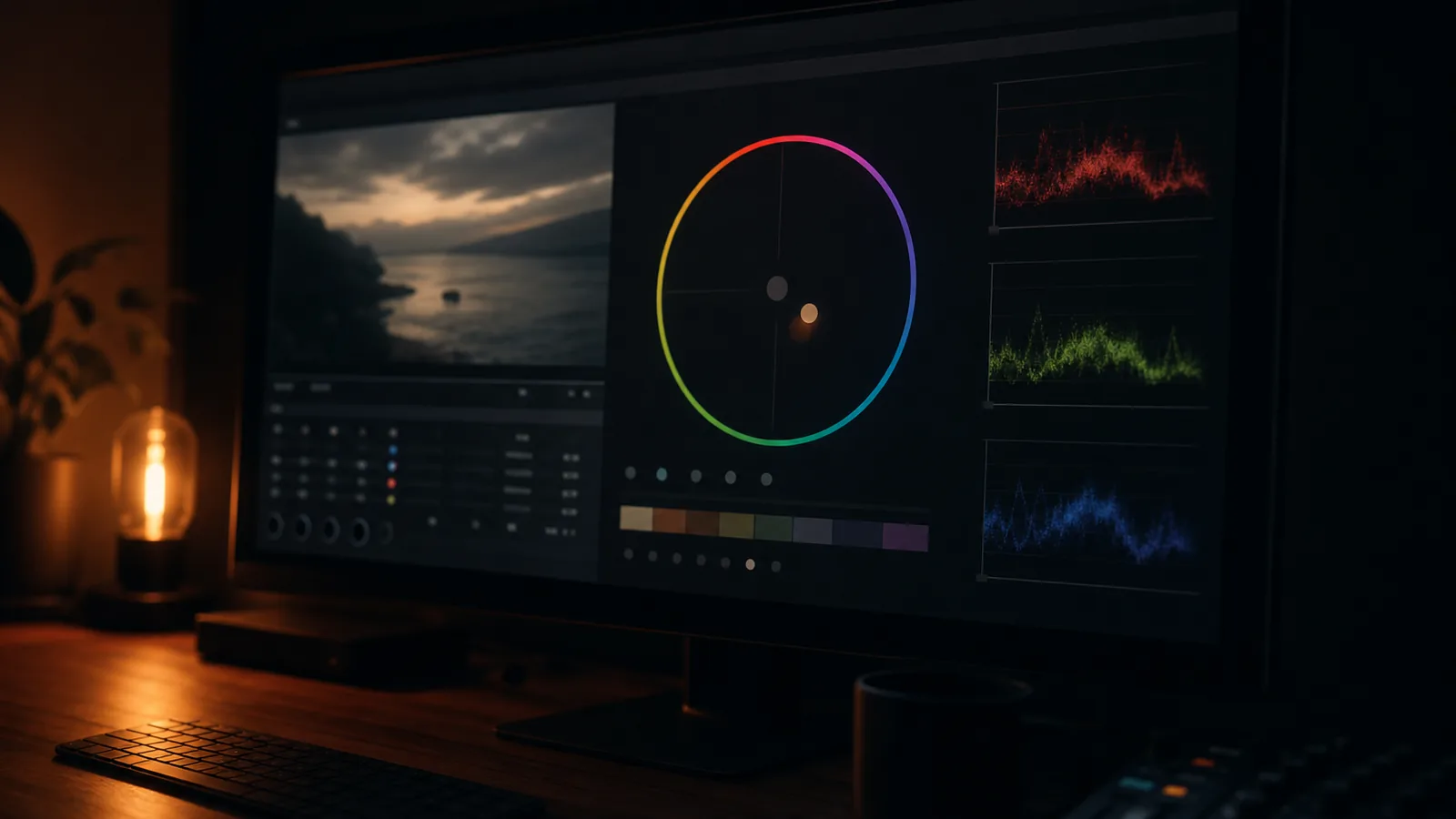
A filter is one decision applied to everything. A grade is a sequence of decisions, each fixing one problem, in an order where each one makes the next easier. Put in the wrong order they fight each other, which is why so many grades end up looking like a filter.
The order, and why it is that order
Normalise first. Every shot gets its blacks and whites set so nothing is crushed and nothing is clipped. This is not creative. It is making the footage usable, and it takes ten minutes per scene.
Match second. Now make the shots look like each other. Exposure, then temperature, then contrast. If shot four was shot an hour after shot one, this is where you reconcile them.
Grade third. Only now does taste enter: the look, the mood, the colour the client asked for.
Skipping to step three on unmatched footage is the single most common mistake, and the result always looks like a filter, because a single creative decision is being asked to cover three different problems.
The four controls that do the work
Lift. Moves the shadows. Raising it washes the black areas out, which is usually wrong; lowering it gives depth. Most flat footage needs a little down, not up.
Gamma. Moves the midtones without touching the ends. This is the control that makes a face look lit rather than grey.
Gain. Moves the highlights. Almost always the one to leave alone, because the white point was already set in step one.
Saturation and temperature. The last two, and the smallest moves. Temperature is easy to overdo because it changes the feeling of a shot immediately and dramatically. Move it in steps of a hundred kelvin, not a thousand.
Skin tones are the reference
Whatever else the grade does, skin has to land in roughly the same place on every shot of the same person. Get one shot right, then match the others to it rather than re-inventing each one. If a face is orange in one shot and pink in the next, no amount of cinematic colour elsewhere will save it.
A useful habit: isolate the face, look at it alone, and check it against the previous shot. Not the whole frame, just the face.
What a grade cannot do
It cannot fix exposure that clipped. It cannot invent detail the sensor did not capture. It cannot make a hard light look soft, or a flat interior look like a set.
And it cannot rescue a shot that is out of focus, which is why the most useful thing a colourist can do on a small job is tell the editor that a shot should come out rather than spend an hour on it.
The tell that it is a filter
Look at the black areas. If they are blue, brown or washed grey rather than black, something is being applied globally. Then look at whether the temperature is identical across a scene shot outdoors at different times of day. If so, it is a preset wearing a grade's clothes.
If you want a look built for your footage rather than bought, that is what the finishing pass is, and it starts with the image you already have rather than a LUT.